

Build Clearer API Development Skills

Explore Courses
Shop allCode With Purpose, Build With Structure
Available on all devices


30-days refund guarantee
Choose Your API Learning Route
-
-
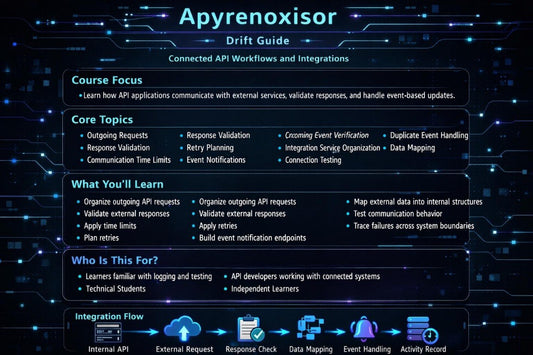
Drift Guide
Vendor:ApyrenoxisorRegular price €219,00 EURRegular price -
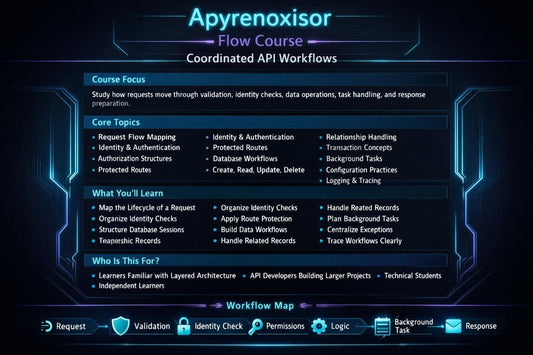
Flow Course
Vendor:ApyrenoxisorRegular price €193,00 EURRegular price

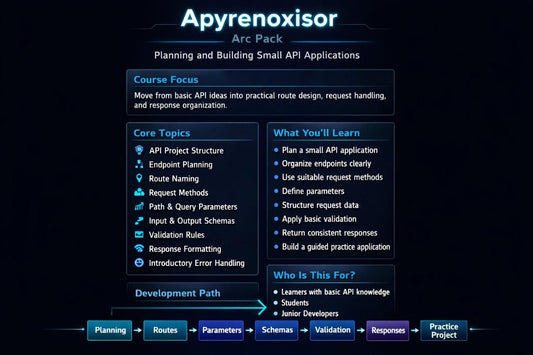


Created Around the Way Developers Learn
The People Behind the Modules
-

Kellan Vossner
API Integration Engineer
Kellan develops connections between separate API services and internal application components. He organizes outgoing requests, response validation, retry rules, and event-based communication. His work supports reliable information exchange across connected systems.
-

Orson Cade
API Testing Analyst
Orson reviews route behavior, validation conditions and error responses through structured testing. He prepares test scenarios for expected and unexpected application conditions. His findings help development teams identify unclear behavior and revise technical components.
-

Zaylie Marlow
API Data Schema Specialist
Zaylie designs request, response, and internal data schemas for API applications. She defines field types, required values, validation conditions, and data relationships. Her work helps keep information structures organized across routes, services, and storage components.


Begin With a Free API Learning Resource
What Each Module Brings to the Table
-

Practical Learning
Guided activities help learners apply technical ideas through route planning, data modeling, testing, and architecture exercises.
-

Clear Structure
Topics follow a logical sequence that connects foundational API concepts with broader development responsibilities.
-

Focused Modules
Each structured module explores a defined topic without combining too many unrelated development concepts at once.
-

Useful Resources
Diagrams, worksheets, checklists, examples, and review materials support independent study and repeated practice.


As follows on


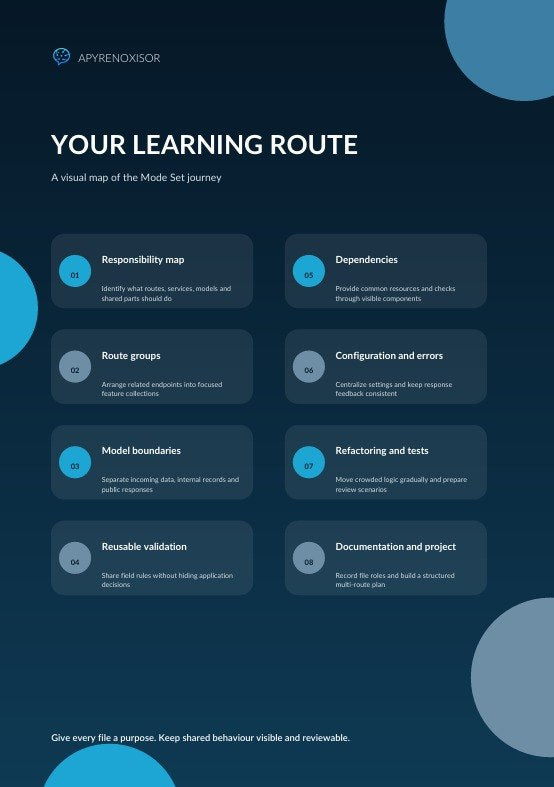
Look Inside the Learning Structure
Notes From the Learning Process
-

Elodie Harper
Elodie began the course while exploring backend development and needed a straightforward introduction to technical terminology and application communication. The concise explanations, planning worksheets, and guided exercises helped her study routes, parameters, schemas, and validation in a logical order. “The course gave me a practical learning sequence that I could revisit whenever a concept needed further review.”
-

Callan Mercer
Callan had created several small endpoints but wanted a more structured way to organize services, data operations, and shared dependencies. The architecture examples and refactoring activities were useful because they showed how crowded files could be divided into focused components. “I appreciated that the materials explained the reason behind each structural choice instead of presenting code without context.”


